
Infracademy
Beyond the Pylon: The Crucial Role of Stay Cables, Saddles and Anchorages
Learn to select, design, and maintain stay cables, saddles, and anchorages for safe, durable cable-stayed bridge structures.
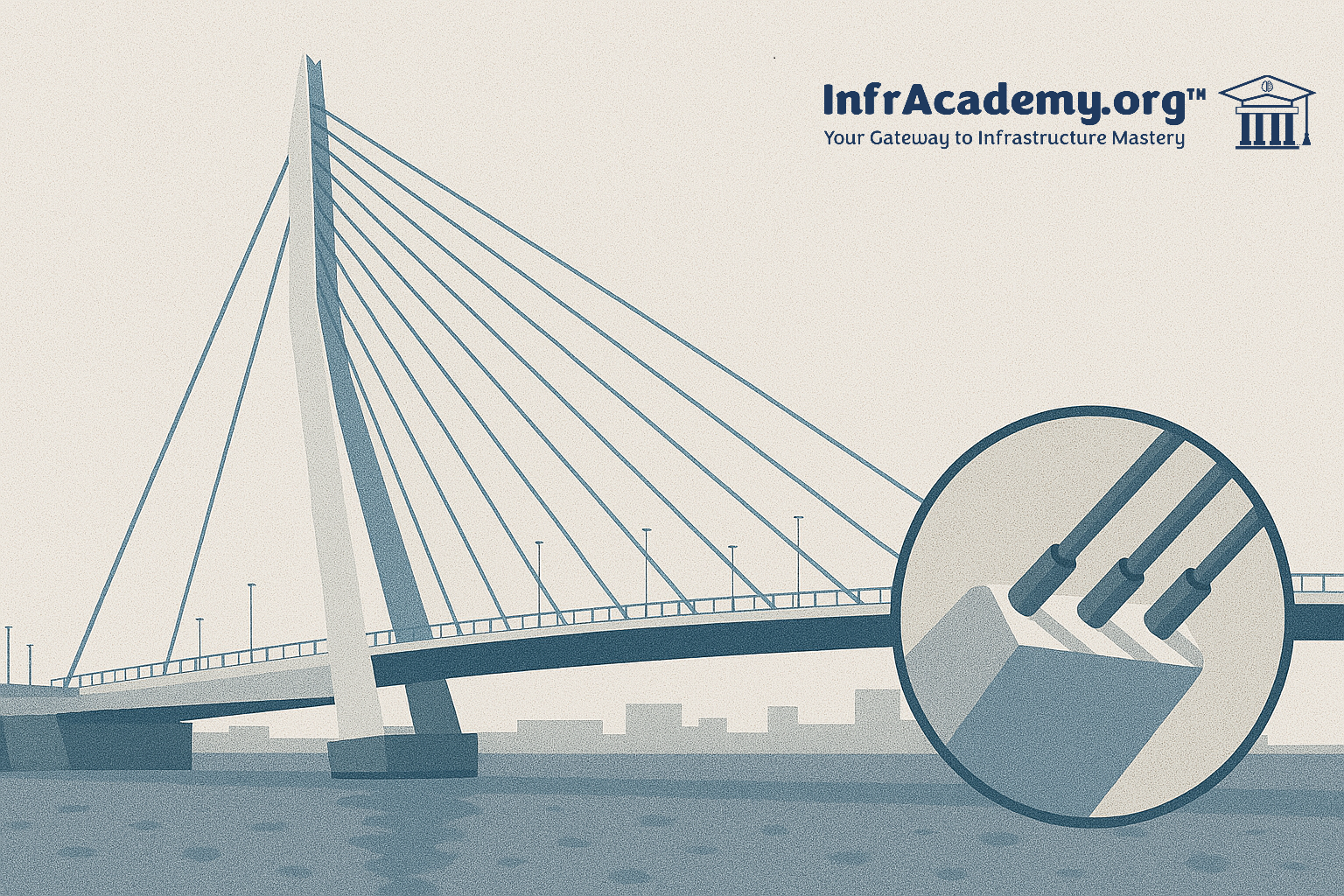

Course description
Beyond the Pylon
The Crucial Role of Stay Cables, Saddles and Anchorages
It connects component fundamentals with selection, design, installation, quality control, maintenance, supplier evaluation, and real-world good and bad practices.
What this course is about
This course gives infrastructure professionals a clear and practical understanding of the systems that carry and secure the forces in cable-stayed bridges: stay cables, saddles, and anchorages. Rather than treating these elements as isolated components, the course explains how they work together, how they influence bridge performance and durability, and how design, supplier choice, installation quality, inspection, and maintenance decisions affect long-term safety and lifecycle value.
Problems we will solve
Learning objectives
- Understand the essential role of stay cables, saddles, and anchorages in cable-stayed bridges.
- Identify appropriate solutions based on project design, loading, span, performance, and maintenance needs.
- Evaluate suppliers using technical evidence, qualification testing, quality systems, and lifecycle considerations.
- Control quality during selection, installation, inspection, and maintenance stages.
- Recognize good and poor practices in design, procurement, quality control, and long-term asset management.
Who should take this course?
- Bridge structural engineers
- Bridge construction leads
- Tender and procurement specialists
- Site managers and project managers
- QA/QC and inspection teams
- Asset, maintenance, and owner-side teams
- Sales engineers working with bridge technologies
Course flow
- Introduction and context setting
- Fundamentals and terminology
- Types, components, and performance factors
- Selection, design, installation, and case studies
- Performance, wear, inspection, and failure analysis
- Best and worst practices, lifecycle cost, and future trends
Your Learning journey for this course
Meet your instructors

Riccardo Pontiggia
Structural Engineer · Bridge Construction Technologies
Riccardo Pontiggia is a Civil Engineer with over 30 years of experience in international infrastructure projects. Currently Business Development Director at Tensacciai, he has held senior leadership roles across various countries worldwide, managing complex civil works and major bridge and transport projects, combining technical expertise in post-tensioning and stay cables with strategic business development.
LinkedIn profile
Pietro Mossone
Structural Engineer · Bridge Design & Supervision
Pietro Mossone is an Italian structural engineer with 25 years of expertise in the design and supervision of a wide range of bridges, supported by a master’s degree in structural engineering. As a Senior Design Director at a leading global consultancy, he combines international design knowledge with practical experience in integrating advanced technologies into high-profile bridge projects.
LinkedIn profileCourse Q&A
Do I need to be a bridge specialist before joining this course?
No. The course starts with the fundamentals and terminology, but it is most useful for professionals who already work around bridge projects, procurement, construction, QA/QC, inspection, maintenance, or technical sales.
Is the course only about cable design calculations?
No. The focus is broader and more practical: system selection, component roles, supplier evaluation, installation risks, quality control, performance, inspection, wear, failure mechanisms, maintenance, and lifecycle decision-making.
What kind of project decisions will this course help with?
It helps learners ask better questions when comparing stay cable, saddle, and anchorage options, reviewing supplier proposals, checking qualification evidence, planning inspections, and balancing cost, durability, constructability, and long-term performance.
Does the course cover good and bad practices?
Yes. The final section is built around best and worst practices, including successful and failed examples, cost-versus-performance evaluation, environmental and economic impacts, and future trends in cable-stayed bridge systems.
How is the course structured?
The course follows Infracademy’s Bloom-5 learning flow: fundamentals, component understanding, practical application, performance and failure analysis, and evaluation of good and poor practices before the final assessment.
Review & rating
Note: this is a static rating display. A working review form requires LMS/backend development.
-
Course Number
TNR-BR-STR-B-002-2025-EN -
Classes Start